

On Meel
After all these years, she still loves to eat

There are moments when my grandma is still, wonderfully, herself.
Recently, as I was helping her get ready to leave my parents’ house, she asked me if I could reattach a piece of formica that had chipped off the edge of the kitchen counter. Overhearing us from the hall, my mother shouted back that she was already taking care of it, she just needed a special kind of glue to fix it.
Grandma leaned in and whispered, in a conspiratorial hush “she’s full of shit.” We cackled in unison; it turns out that the sequined sugarplum fairy of my childhood still has a salty sense of humor.
My grandma – Meel, short for Emilia – is my last living grandparent. Our relationship is one of mutual and absolute adoration. She was my favorite childhood babysitter, and not just because she’d spoil me rotten. She alone saw my sensitivity, my more introverted tendencies, and nurtured them, battling my grandfather whenever he wanted me to go outside.1 Throughout my twenties, when I would periodically call to check in on her, she’d pick up the phone and always offer the same greeting: “Hi my love.” My mother and aunt get called by their first names; for her, “Christopher” and “love” have become one and the same.2
Meel turned 91 in September, a paragon of resilience. Diabetes, breast cancer (twice), heart disease, pulmonary issues and COVID have all tried to stop her and failed. Like death and taxes, her longevity has become a surety.
Still, she’s slowed down. After a vibrant decade of widowhood her momentum was blunted by an extended hospital stay in 2021. She was left frailer, physically and mentally. Scared of living alone again, she gave up her social circle at her condo complex and moved in with my aunt and her family. She uses a walker now, or sometimes a wheelchair. Her memory has gotten spottier; she can remember the long ago and the very recent, but the stuff in the middle can sometimes be a blur. To our disappointment, Meel’s gotten old.
Which is to also say that she’s gotten young again. After years of independence she’s now depends on her daughters for everything, an inversion of their lifelong relationship. The woman who once batted away worries with the back of her hand and drank martinis between puffs of her Virginia Slims now hates not having my mother or aunt within shouting distance. She’s grown scared of the dark and it’s rare that she sleeps through the night without calling for her daughters in her sleep, sometimes for hours. They lament that no treatment plan seems to help, but what can one do with a 91-year-old who never wants to be alone?
Nowhere is this regression more evident than in her eating habits. Her days are structured around her meals, and she gets cranky whenever there’s deviation from the norm. Dessert is never optional and don’t you dare tell her otherwise. If something gets set down on the table while she’s sitting there, she’ll pull it closer for inspection. Held delicately between her fingers, bent with arthritis and studded with rings, she’ll raise the object up to observe it from every angle. As she looks, you can see her thinking “is this something I can eat?” When she’s discerned the answer, she either pops it in her mouth (yes, I can eat this), or places it back on the table (no, I can’t eat this).
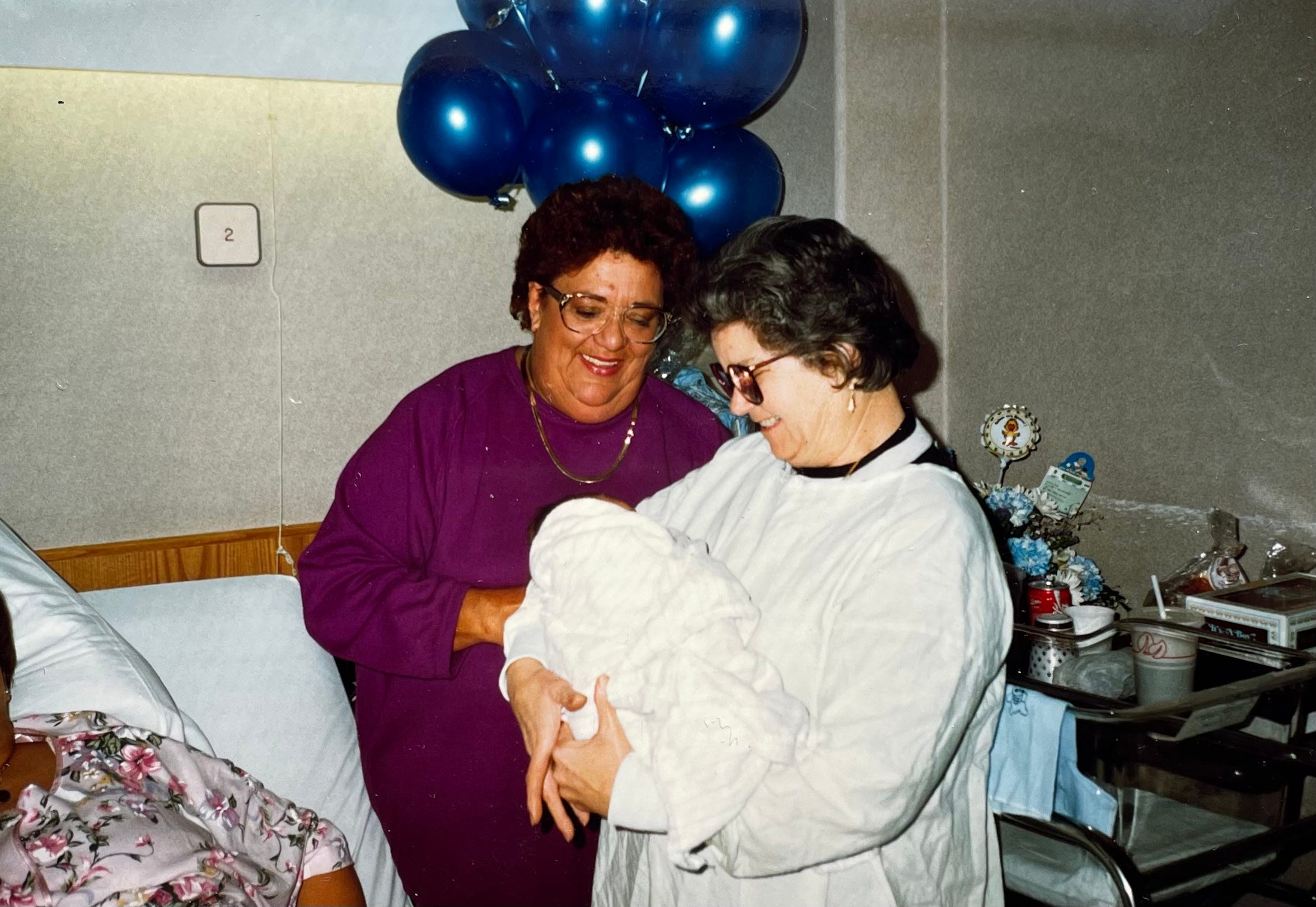
I don’t begrudge Meel’s new fixation on food: she’s eating because she’s bored. Her world narrowed more quickly than she anticipated or wanted. Now she has too much time and not enough to do. Food has become the something that keeps her occupied. Fifteen minutes spent enjoying a handful of cashews is better than fifteen minutes spent staring into space.
And at least eating remains a pleasure. We’re lucky in this regard; while much about her has changed in the last few years, her appetite remains intact.3 When she comes to stay with my parents for the day I plan a meal I think she’ll enjoy. Seated at the table she’ll clean some garlic or peel carrots for me while I work at the stove, bringing her morsels to enjoy. For days after she’ll rave about how it was the best meal she’s ever had, how she can’t wait to have it again. Is this hyperbole? Undoubtedly.4 Is this genuine joy? Unquestionably.
These meals are a joy for me too. Usually they knock loose a memory, a tale she’s never told. Over scampi with polenta, she recounts how her neighbor Betty used to stir a cauldron of polenta for what seemed like hours; after a hot open-faced sandwich, she reveals that she had a “football wedding,” where, so it’s said, sandwiches were tossed between guests until everyone had what they wanted. These are the moments she seems most like herself again. The taste takes her back, and while she revels in her past we revel in her present.
I hope Meel always has an appetite. I hope she squeezes every ounce of pleasure there’s to be had from this life. I want her to enjoy pasta and clams and cannolis (not all together) until the end. Even when she dies — and who knows, she might outlive us all — I hope we never lose her.
If you made it this far, thank you, and thanks for coming to visit My Nonna Era! If you want to support my writing, or if you love Meel, please share this essay on social media and tell your friends to subscribe.
It’s perhaps no surprise that she’s the only grandparent I came out to. When I called to tell her, she said she’d love me even if I was in prison. Was this implied proximity between gayness and criminality still a little homophobic? Maybe, but I found the sentiment touching nonetheless.
To be fair, when she didn’t check her caller ID she’d assume by my voice I was my mother. I’d play along for a minute or so until I revealed my deception.
Looking through photos of her past, she’ll point to herself and say “there’s fat Meel.” She says it with disdain, but when I look at these same pictures I’m in awe of her magnificent, sparkling rotundity, like Ursula the sea witch.
She did, recently, tell my mom that she wasn’t a fan of my latest batch of pasta e fagioli. Devestating.
Love you and love Meel. It’s beautifully written!