

Nonna Nirvana
A Twenty-Year Search for the Perfect Caesar Salad

A friend recently posed this question to me: what’s the one thing you can order almost anywhere that gives you immediate insight into the overall quality of the restaurant you’re at?
My answer: a Caesar salad. A Caesar salad can reveal not only the culinary idiosyncrasies of a kitchen — how they hew to or buck from the traditions of a hundred-year old recipe1 — but also their level of care towards a dish that’s so ubiquitous it’s lost some of its exciting dazzle. The salad of the season can shine on a menu, but what attention to detail is being paid towards the old stalwart?
Is the romaine bright and green or already looking sad and brown? Has the parmesan been freshly grated into a fluffy cloud, or have you been condemned to the pre-shredded stuff? And what about the dressing: too much, not enough? Does it have punch and nuance, or does it just taste like a sodium bomb?
I wasn’t always this demanding of my Caesar salad. When I had my first bite at the long-defunct Leonia Cafe in the early 2000s, I had only ever had salad a la Nonna (iceberg lettuce, cucumbers, oil and vinegar, salt). I enjoyed her salad with the same gusto that I enjoyed plain white rice: I craved its simplicity, its predictability.
That’s probably why the Caesar salad rocked my world. Suddenly, here was something green with complexity! A creamy dressing that hit the perfect triad of salty, tangy, and umami, the crisp cool lettuce contrasted with crunchy croutons. It quickly became the only thing I ordered from the cafe,2 and I knew the restaurant was going downhill when the salad lost its dazzle.
I’ve been chasing the high of this first encounter with Caesar salad ever since. It’s likely that the dish I had at Leonia Cafe was perfectly mediocre, as most Caesar salads usually are. I was probably blinded by the sheer novelty of it, but I still stand by the judgment of my pre-adolescent palate. I knew, even then, that I had encountered something that could be delicious, something that could be special, in the right hands.
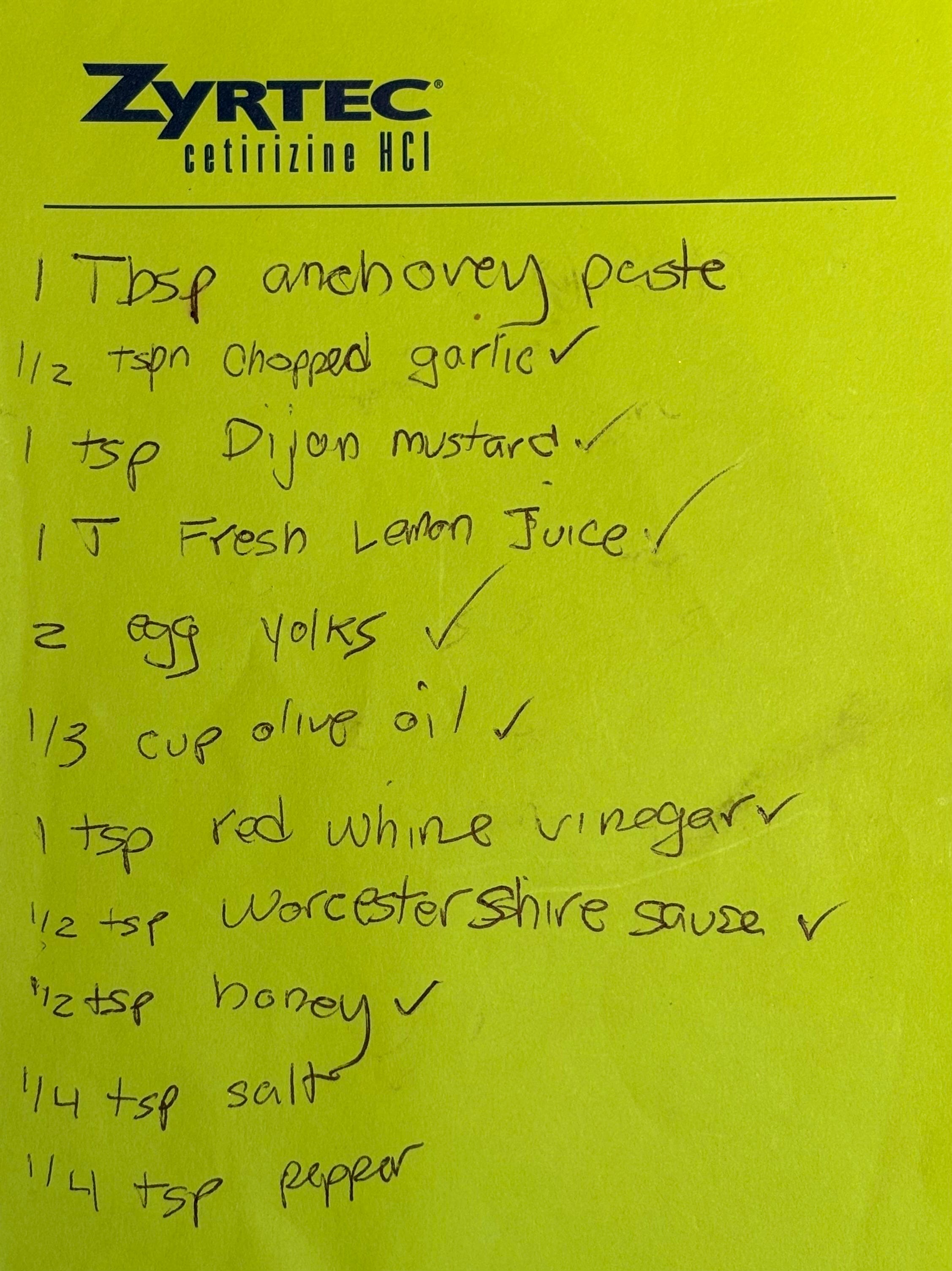
And yet, despite my best efforts, for years I struggled to make Caesar salad at home, mostly because I’ve struggled to find or make a Caesar dressing that satisfied me. I’ve tried every bottled Caesar dressing you could imagine and ultimately found they’re all just fine; too muted, too shelf-stable to really hit my tastebuds in the way I want. But when tasked with making my own Caesar dressing, I always end up with something closer to a Caesar vinaigrette. I’ve never been quite patient enough to whisk the egg yolk and oil into a stable emulsion. Respectfully, does anyone really have the patience needed to add oil into an egg yolk “a drop at a time”?3
I had resigned myself to Caesar salad mediocrity, when I found inspiration in the most unlikely of places. I was paging through Molly Baz’s Cook This Book while visiting Mark a few years ago, looking for something to make for dinner. I have some beef with Ms. Baz — she’s never met a handful of salt she didn’t like — but it’s the only cookbook Mark owned at the time, so it was all I had to work with.4
In the back of the book, where Molly rather helpfully compiles recipes for all the different dressings and toppings that garnish her dishes, I discovered a recipe for what she calls “Caesar-ish Dressing.”5 The ingredients were pretty familiar — garlic, anchovy, dijon mustard, lemon juice — but with one surprising ingredient: 2/3 cup of mayonnaise.
On the one hand, this makes perfect sense: egg yolk emulsified with oil is, ultimately, just mayonnaise made by hand. But, at the same time, I had never, ever encountered a recipe for Caesar dressing that encouraged its reader to take this shortcut, to just use the readily available, perfectly stable emulsion that’s probably sitting in your refrigerator right now. It felt like cheating.
Despite these fears about my culinary integrity, I pressed ahead with Molly’s deceitfully simple recipe. With my first taste, all I could think was “this is it.” All the flavors perfectly balanced in a satisfyingly creamy texture. It’s thick and punchy enough that a little goes a long way; when dressed, the salad never feels to heavy or — even worse — gloopy, but rather bright and spirited.
I make a serving of this dressing once a week now and keep it in the fridge for easy Caesar salad assembly when the moment strikes. Susan and Manny both love it: they, too, experienced my years of underwhelming Caesar salads with brave faces, so this is a victory for them as well.
This Caesar dressing is, I think, the closest I’ve gotten to Nonna nirvana so far. I no longer carefully measure out the ingredients, I just eyeball it. This freewheeling approach to the recipe feels like liberation rather than flailing. It’s the acceptance that no two dressings will be alike because the ingredients themselves will vary: garlic cloves and lemon halves will never be quite the same size, mustard and anchovy paste will lose its pungency once opened.
But that’s all okay. I’ve found the recipe that works for me. That’s something worth hailing to.
Thanks for reading My Nonna Era! If you enjoyed this essay, please feel free to share it far and wide. Bully your friends into subscribing! DO IT, NERD!
I would order it topped with grilled chicken too because I had the vague sense that this combo of protein and lettuce was “healthy,” not yet realizing how calorically dense salad dressing can (and should) be.
I’m sure plenty of you reading this do have that patience, but if you do I think you need to take a look in the mirror and question your life choices.
He has, since, purchased a second cookbook on Italian summer cooking, bless his heart.
This recipe was originally intended for a potato salad, but I’ve used it with greens of all kinds with fantastic results.